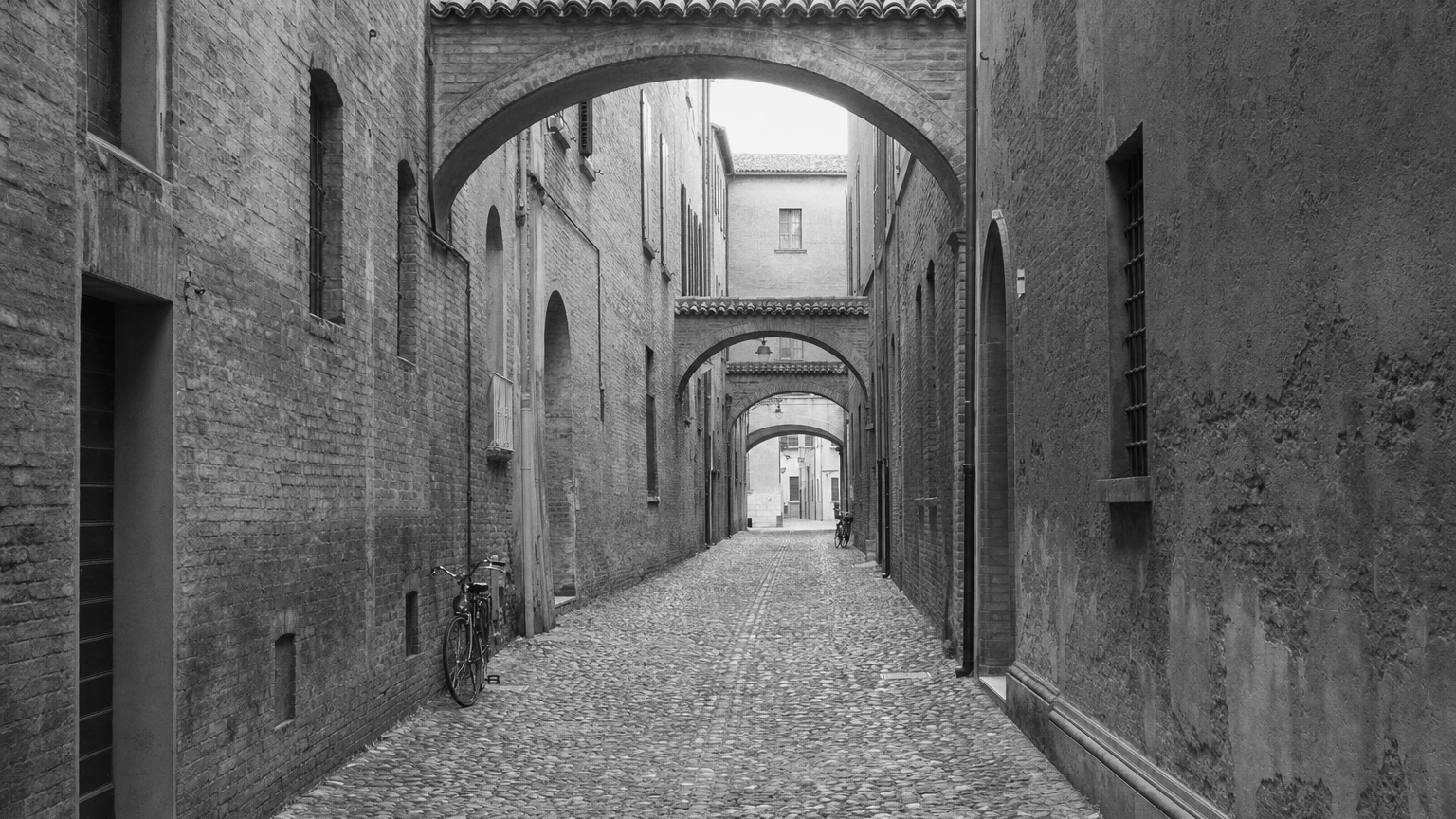
A city to be taken slowly. Red brick, wide streets that end in a vanishing point, medieval lanes that appear where you least expect them. Ferrara is in no hurry, and neither are we.
If you're wondering what to see in Ferrara in one day, the short answer is: more than you'd think, and without rushing. It's a small, flat city, made for legs and bicycles. Below we tell you about the day as we at Le Nuvole would spend it, starting at the Castle and ending in the evening. Which, incidentally, is the part we like best.
Ferrara, city of the Renaissance (and a World Heritage Site)
Let's start with something people in Ferrara take for granted, and shouldn't. Since 1995 the city has been a UNESCO World Heritage Site under the name “Ferrara, City of the Renaissance, and its Po Delta”; the listing was then extended in 1999 to include the Delta and the Delizie Estensi, the Este family's country residences.
UNESCO describes it as the first city to put the harmony of its urban perspectives before the beauty of any single building. In our words: it's not just the palazzo that counts, it's how you see it as you approach from a distance. That's something you understand by walking rather than reading. Keep it in mind: it will come in handy later, when we head into the district that made Ferrara famous among town planners the world over.
The Castello Estense, where everything starts
The Castello Estense is the symbol of the city, and it's where people arrange to meet. Four towers, a moat full of water, red terracotta brick, white balustrades, drawbridges. A real medieval fortress, still whole. You can climb the Torre dei Leoni: from up there you take in at a glance how Ferrara is put together, the old meeting the new.
From here on, the distances are almost laughable. Everything we describe is within a few hundred metres of everything else. That's why Ferrara works so well in a day: you don't waste time getting around, you spend it looking.
The Cathedral, the Listone and the former ghetto
A stone's throw from the Castle is Piazza Trento e Trieste, which people in Ferrara call the Listone: for many it's the heart of the city, the open, theatrical space where people pass through, stop, arrange to meet.
On one side stands the Cathedral of San Giorgio Martire, the Duomo. Its façade is a conversation between two eras: the lower part Romanesque, begun in 1135, with Saint George slaying the dragon, signed by the sculptor Nicholaus; the upper part Gothic. Along the square runs the Loggia dei Merciai, the old shops built up against the church. Entry is free.
From the Listone runs Via Mazzini, which was, so they say, the main street of the old Jewish Ghetto. It's a part of Ferrara worth getting to know: here you'll find the MEIS, the National Museum of Italian Judaism and the Shoah, in Via Piangipane, which tells more than two thousand years of Jewish history in Italy. If you have the time and the inclination, it's a stop that leaves its mark.
Via delle Volte, medieval Ferrara
Now a tip from people who live here. Slip into Via delle Volte.
It's a medieval street, the backbone of the old Ferrara that grew up between the 7th and 11th centuries. The name comes from the vòlti: the covered passageways and arches that once linked the warehouses on the riverbank to the shop-houses towards the centre. The river is long gone, but the arches are still here. Half-light, cobbles, buildings six and seven hundred years old. It's the most secret Ferrara, and on days when the light is low it's also the most beautiful to photograph.
Palazzo dei Diamanti and the Addizione Erculea
And now to the part that makes Ferrara a textbook case. Take Corso Ercole I d'Este: a dead-straight axis, almost two kilometres long, running from the Castle up to the northern walls. Not a single shop along the way, not one sign. Only palazzi and perspective.
It's the heart of the Addizione Erculea, the “Herculean Addition”, the expansion that Ercole I d'Este entrusted in 1492 to the architect Biagio Rossetti. Rossetti doubled the city northwards on a rational, orthogonal grid and fused the medieval core with the new extension. That's why Ferrara is so often cited as one of the very first examples of a modern city in Europe, the one that, they say, invented the idea of the urban master plan.
Halfway along the Corso opens the Quadrivio degli Angeli, the striking crossroads where four palazzi face one another. The most famous is the Palazzo dei Diamanti: it owes its name to its outer facing, some 8,500 blocks of white marble veined with pink, cut to a diamond point. It changes colour with the light of day. Inside are the Pinacoteca Nazionale and the big international exhibitions. It's worth checking the programme before you set off, because it changes from season to season.
Palazzo Schifanoia and the Salone dei Mesi
If you have energy (and curiosity) left, there's another place we hold dear: Palazzo Schifanoia, and inside it the Salone dei Mesi, the Hall of the Months.
It's one of the great fresco cycles of the Renaissance, painted between 1468 and 1470 at the behest of Borso d'Este by the painters of the Officina Ferrarese, Francesco del Cossa and Ercole de' Roberti among them. Of the original twelve months, seven can still be read, from March to September: deities, signs of the zodiac, scenes of court life. A painted calendar, crowded with life. The name of the palace, “Schifanoia”, meant roughly “shun boredom”. A statement of intent we rather like.
The walls: a 9 km green ring, best by bike
We close the loop where Ferrara is at its best for anyone who wants to be outdoors: the city walls.
They circle the historic centre for around nine kilometres, an unbroken ring of bastions, towers and gates, walkable and cyclable from end to end. From Corso Ercole I d'Este you reach the Porta degli Angeli, where the Addizione Erculea touches the northern edge of the city. Up here it's all green, silence and bicycles. And here Ferrara takes off its history-book mask and goes back to being simply a lovely place to breathe.
One detail says it all: in Ferrara around 90% of people own a bicycle, and some call it the most bike-friendly city in Italy, with more than two hundred kilometres of cycle paths. If you can, get hold of one. The city is flat and the distances tiny: pedalling here isn't sport, it's simply the natural way to get about.
The evening, at our place
By now it's nearly dark, the legs have done their walking, and Ferrara slowly empties. It's the hour we like best. The light fades, the bricks glow orange, and you feel like stopping.
We're here, a small fish trattoria run by two pairs of hands: Paolo in the kitchen, Eli front of house and in the cellar, with her artisan winemakers. The sea and the lagoons around here, a few off-menu specials told to you at the table, good wine and no hurry. After a day spent looking up, it seems to us the right way to close it: seated, in the warmth, in front of something good.
If you're passing this way, the table is ready.
Frequently asked questions
What should you see in Ferrara in one day?
A few hours are enough for the heart of the city: the Castello Estense, the Cathedral and the Listone, Via Mazzini with the former ghetto, medieval Via delle Volte, Corso Ercole I d'Este with the Palazzo dei Diamanti, and a turn along the walls. If there's time to spare, Palazzo Schifanoia with the Salone dei Mesi. All close together: no need to rush.
Is Ferrara a UNESCO World Heritage Site?
Yes. Since 1995 it has been a UNESCO World Heritage Site as “Ferrara, City of the Renaissance”, and since 1999 the listing has also included its Po Delta and the Delizie Estensi.
Is Ferrara better on foot or by bike?
Both work: the centre is small and easily done on foot. But it's a flat, thoroughly cyclable city, among the most bike-friendly in Italy, so for the walls and for going a little further afield the bike is the natural choice.